
New York, September 12, 2026: OpenAI’s claim of solving one of the world’s most famous unsolved mathematics problems has triggered a fierce debate among mathematicians, with some researchers questioning not the power of the artificial intelligence itself, but the way OpenAI pursued and presented the breakthrough.
On September 8, OpenAI announced that an internal AI system had produced a solution to the Navier–Stokes existence and smoothness problem, one of the seven Millennium Prize Problems. The company also released a written proof and a formalized version in Lean.
But what looked like a historic AI achievement quickly became embroiled in controversy.
Why Are Mathematicians Angry?
The dispute centres on credit, transparency and research ethics.
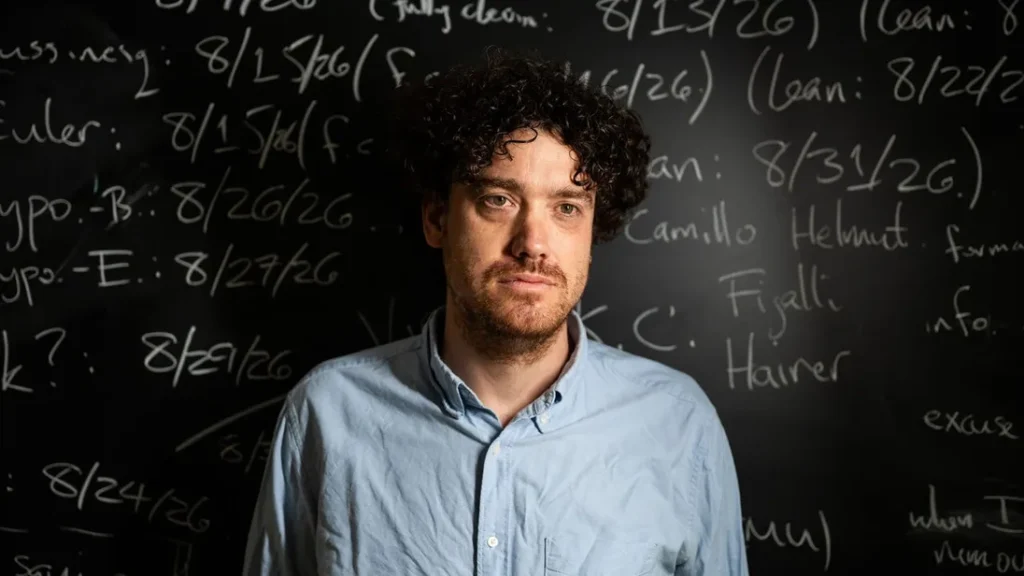
NYU mathematician Tristan Buckmaster and Anthropic researcher Levent Alpöge had been working on closely related Navier–Stokes problems. Buckmaster has alleged that OpenAI moved rapidly on the problem after learning about their work and that discussions over who should receive credit became contentious. OpenAI has denied that its system was influenced by Buckmaster’s private work.
The controversy has raised a difficult question for the mathematical community: What happens when AI companies enter academic research with vastly greater computing resources and commercial incentives?
OpenAI Says Its Proof Is Independent
OpenAI maintains that its internal system’s work was independently developed.
The company said it investigated whether Buckmaster’s Codex prompts from the two months before the announcement could have influenced the system and concluded that they could not have done so, including through training. OpenAI also said its proof differs significantly from the researchers’ concurrent work.
OpenAI has also stressed that it does not intend to claim the $1 million Millennium Prize for the result.
A Historic Claim With Huge Implications
The Navier–Stokes problem concerns equations that describe the motion of fluids such as water and air. It has challenged mathematicians for generations and is one of the Clay Mathematics Institute’s seven Millennium Prize Problems.
OpenAI says its internal system demonstrated that Navier–Stokes dynamics can develop a singularity in finite time. The company published both its mathematical write-up and a Lean formalization of the proof.
If independently validated by the mathematical community, the achievement would represent an extraordinary milestone for AI-assisted mathematical research.
The Bigger Fight: Can AI Change Mathematics?
The controversy goes far beyond one proof.
Mathematicians are increasingly debating whether AI should become a standard research partner, a tool for discovering proofs, or even a system capable of replacing parts of traditional mathematical research.
Earlier this year, OpenAI released ten AI-generated mathematical and theoretical-computer-science results, saying they either solved or made substantial progress on longstanding open problems.
Some leading mathematicians see enormous potential in these developments. Others worry that AI-generated mathematics could produce huge amounts of material that humans struggle to verify, understand or properly credit.

A New Era — But With New Rules Needed
The debate has become so serious that thousands of mathematicians have called for stronger norms around AI-assisted mathematics, including proper verification and attribution.
The central concern is not simply whether AI can solve difficult equations. It is whether the traditional values of mathematics—independent verification, transparency, collaboration and proper credit—can survive in an era when AI companies can deploy thousands of agents and enormous computing power.
OpenAI’s Navier–Stokes claim may ultimately be remembered as a landmark achievement—or as the beginning of a much bigger debate over how AI should conduct scientific research.