
The unveiling took place at a SpaceX test facility in Texas on October 15. However, despite the eye-catching demonstration, customers will have to wait longer to get behind the wheel, with production targeted for 2028.
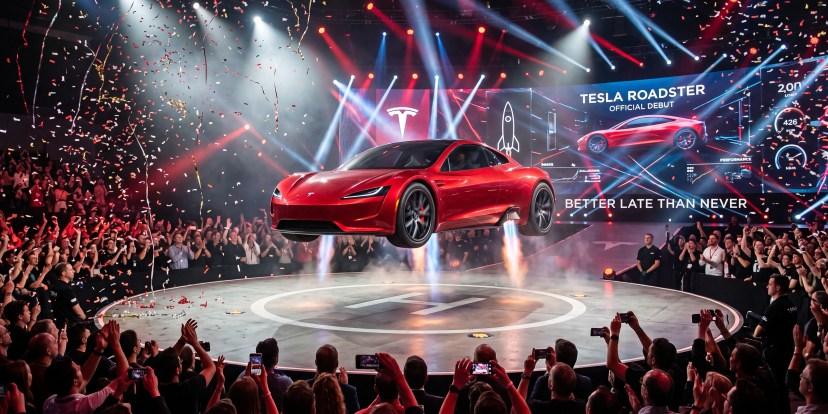
Tesla Roadster Turns a Supercar Into a Flying Spectacle
The highlight of the event was a demonstration showing the white Roadster travelling up an inverted ramp, turning in the air and returning to the ground using thrusters. Tesla also demonstrated the vehicle lifting over other cars during a spectacular sequence.
The system combines high-pressure air tanks, cold-gas thrusters and a fan-based suction mechanism. The suction system helps the car maintain contact with an inverted surface, while the thrusters provide the force needed for aerial manoeuvres.
Although the demonstration resembled science fiction, it was a controlled technical showcase rather than evidence that ordinary road cars can routinely fly. The vehicle’s real-world capabilities, safety requirements and regulatory status remain important questions.
SpaceX Technology Powers the Roadster’s Ambitious Design
The new Roadster represents an unusual collaboration between Tesla’s electric-vehicle engineers and SpaceX’s aerospace specialists. Elon Musk has previously discussed adding rocket-style thrusters to the sports car to improve acceleration, braking and handling.
At the unveiling, Tesla demonstrated how the thruster system could help the car perform movements beyond the capabilities of conventional production vehicles. However, the flying demonstrations do not mean that every Roadster variant will be able to take off or perform the same manoeuvres on public roads.
Tesla has described different configurations, including a performance model and a version featuring acceleration thrusters. A more specialised, invitation-only Rocket version is also described as having a full flight system.
Acceleration Under One Second and Speeds Above 230 MPH
Tesla has made extraordinary performance claims for the Roadster. According to the company’s presentation, the car can accelerate from zero to 60 mph in less than one second and reach speeds exceeding 230 mph, or approximately 370 km/h.
Tesla also says the vehicle will travel more than 300 miles, equivalent to around 480 kilometres, on a single charge. These figures are manufacturer claims and will need to be assessed against final production specifications and independent testing.
The performance figures place the Roadster in the high-performance electric sports-car category, although the addition of thrusters introduces technical and safety challenges that conventional electric vehicles do not face.

Why Will the Tesla Roadster Not Arrive Until 2028?
The Roadster’s long development history has become part of the story. Tesla first revealed a next-generation model in 2017 and initially expected deliveries in 2020. The programme subsequently experienced repeated delays as the company focused on other vehicles and technologies.
The latest unveiling provides a clearer demonstration of the concept, but Tesla is still targeting 2028 for production. The company has not yet provided a fully detailed delivery schedule that would guarantee when customers will receive their cars.
Tesla’s reservation page lists a Performance version requiring a $50,000 deposit and a Thrust version requiring a $250,000 deposit. The company has also described an invite-only Rocket configuration. Final pricing and production details remain subject to confirmation.
A Technology Showcase as Tesla Expands Beyond Traditional Cars
The Roadster arrives as Tesla places increasing emphasis on autonomous driving, robotics and other advanced technologies. The company has presented the car as a showcase for its engineering ambitions rather than a product expected to transform its finances on its own.